For carers
A good carer,
everyone gets into fights from time to time
Mediation is a peaceful way of resolving conflicts by intervening in distressing behaviour as early as possible. It is one conflict management tool alongside other methods. Mediation is a clear approach whereby mediators help the parties to a conflict to find a solution to their conflict themselves. It allows the parties to share their views, describe their feelings and consider different options for a solution without fear of punishment. Mediation lays the groundwork restorative theory, on which there is a wealth of research. Restorative mediation widely used in society.
Mediation in early childhood education, primary and secondary education supports the practice and learning of social skills in the community. Through conflict resolution, it can model how community members interact with each other in ordinary everyday situations. Through mediation, children and young people learn emotional and interpersonal skills, empathy and responsibility for their own actions. Mediation supports the objectives of the early childhood education and care curriculum and the basic education curriculum. Read more about restorative approaches and mediation in early childhood education and care and education starting points and criteria.
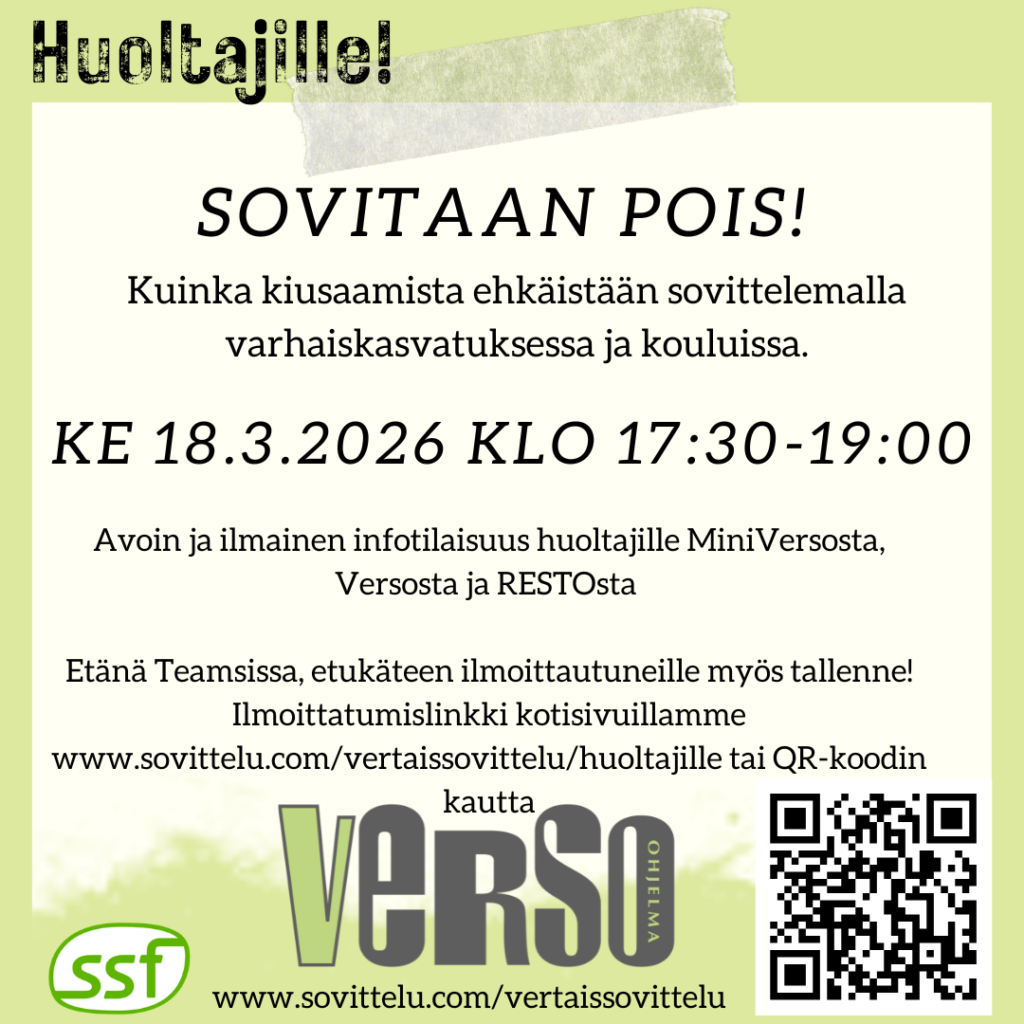
Every year, we organise carer webinars open to all interested parties, free of charge. The next event is on Wed 18 March at 17:30-19:00 - you are warmly welcome to join us! You can find the registration form here: https://forms.gle/iJauZDExzPo6DKMd9

Our mediation activities:
Conciliatory parenting:
tips for home
The VERSO programme organises HuVe-info sessions for carers to introduce mediation activities. The aim of the HuVe-info is to bring carers together to mediate and to bring together family, early childhood and school practices in conflict resolution to support each other. To subscribe to the HuVe-info, please contact your child's ECEC unit or school. Parents' associations can also subscribe to the info.
Mediation activities in early childhood education and schools are constantly monitored through surveys and studies. The results show that children and young people are experts in their own community and are highly capable actors when community peace is safeguarded. Read more about the VERSO programme about the study.
STEA supports mediation activities in learning and education communities with the proceeds of the Veikkaus. The VERSO programme launches and maintains mediation activities through training in early childhood education units, primary schools and secondary schools. The VERSO programme aims to build restorative communities where mediation is used as a method of dealing with various everyday conflicts.